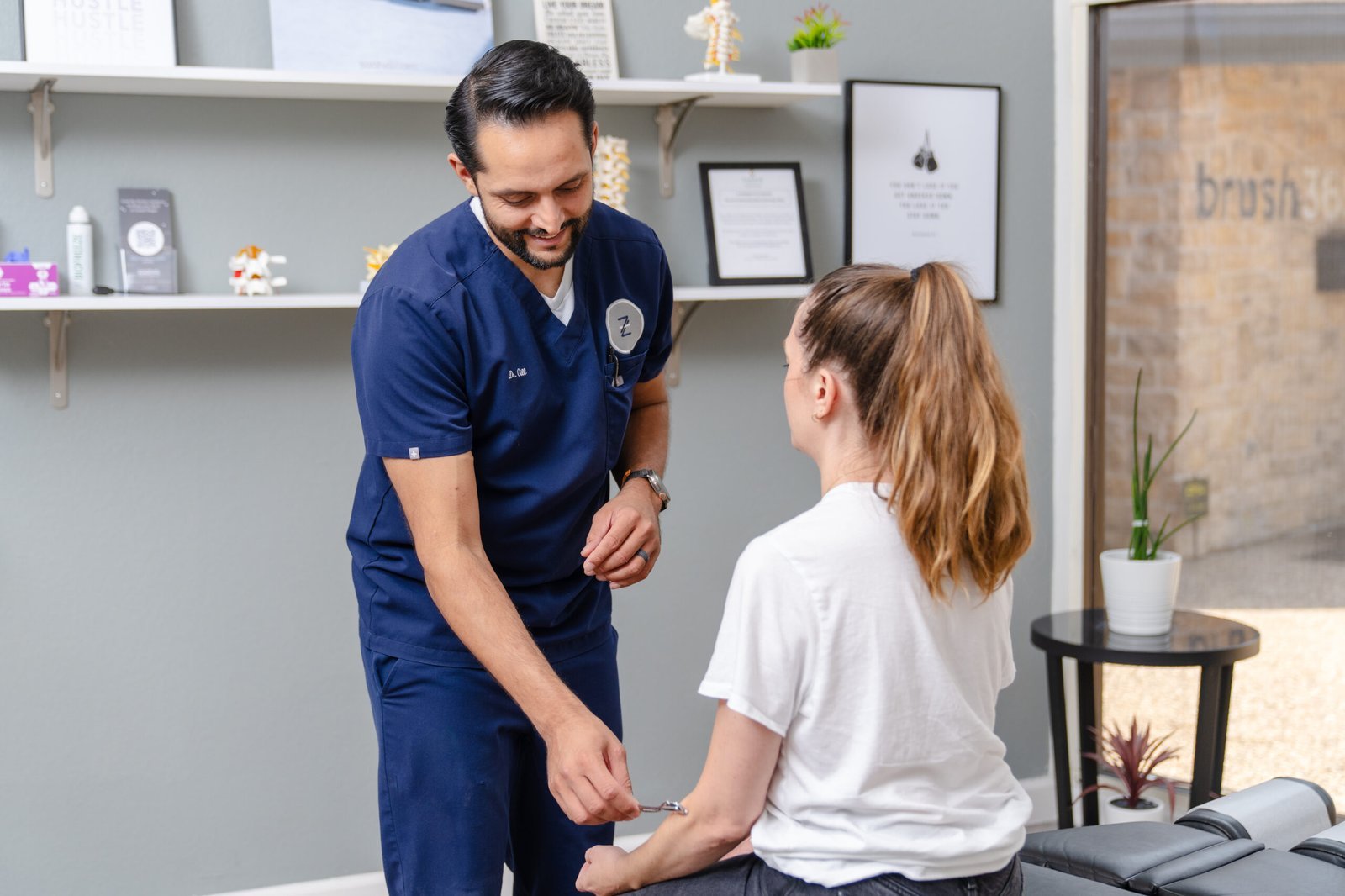

Pain can tell you that something is wrong. It does not always tell you what the body is having trouble doing.
A person may have normal imaging but still struggle to rotate comfortably, balance on one side, bend through a full range of motion, or control a movement that used to feel automatic. Those limitations are easier to understand when the body is observed in motion rather than evaluated only at rest.
A functional movement assessment looks at how the joints, muscles, balance, and coordination work together during common movements. At ZENITH Injury Relief & Wellness Clinic, these assessments help establish a functional baseline and give the team more direction when deciding which type of care may be useful next. This reflects ZENITH’s broader approach of evaluating movement, not just pain.
What a Functional Movement Assessment Can Reveal
The assessment focuses on how the body performs rather than simply where discomfort is located.
Depending on the patient and the reason for the visit, the clinician may look at range of motion, flexibility, balance, control, joint mobility, and the quality of movements such as bending, rotating, reaching, or changing positions.
The value is often in the details. A patient may be able to complete a movement but struggle to control the final part of the range. One side may be noticeably less mobile than the other. Balance may decrease when more load is placed through an injured leg. A movement that looks normal initially may become less coordinated after several repetitions.
Those findings provide information that symptoms alone cannot.
They can also add context when imaging appears normal. X-rays are useful for identifying structural concerns, but they do not show how effectively the body is moving during everyday activity. ZENITH’s injury-care approach distinguishes between structural imaging and movement-based assessment for this reason.
Understanding the difference between mobility and flexibility after an injury can also be important. Being able to reach a certain range does not necessarily mean the body can control that movement effectively.
How Movement Findings Shape the Treatment Plan
A movement assessment becomes useful when the findings influence what happens next.
If joint motion is limited, chiropractic care may be used to improve mobility. When weakness, balance, or movement control is the larger issue, physical rehabilitation therapy may become more important. Significant stiffness may point toward stretch therapy, while muscular tension or soft tissue restriction may call for more targeted hands-on treatment.
At ZENITH, those services are selected based on what the assessment shows rather than added automatically. A restricted joint, weak movement pattern, tight muscle, and disc-related problem can all produce discomfort, but they do not call for the same type of care.
This is also why chiropractic care and physical rehabilitation may work together after an injury. Improving joint motion and rebuilding the strength and control needed to use that motion address different parts of recovery.
As function improves, the emphasis of treatment can change. Some services may become less necessary while rehabilitation or mobility work takes a larger role, depending on what the patient is able to do at that stage of recovery.
Why Movement Can Be Reassessed During Recovery
Functional movement assessments are not only useful at the beginning of care.
Repeating parts of the assessment later can show whether range of motion has improved, balance is more stable, or a previously difficult movement can now be performed with better control. Re-examinations at ZENITH are used to track progress and guide treatment adjustments as recovery continues.
This becomes especially useful when a patient is returning to work after an injury, exercise, sports, or another physically demanding routine. Reduced pain is encouraging, but the body also needs to tolerate the movement and load those activities require.
If an injury, stiffness, or loss of mobility has changed what your body can comfortably do, schedule an evaluation with ZENITH. A functional movement assessment can help clarify what is limited and whether chiropractic adjustments, physical rehabilitation, stretch therapy, soft tissue care, or another service should play a role in restoring function.